Writings by Angela Lorenz
Artist's Books - For Lack of a Better Name
Research in the Works
Art in Sequence
Engaging Visitors
Art in Isolation with Angela Lorenz, Walt Whitman, Primo Levi and r.ed monde
Unsuspected Books
Selected Bibliography by the Artist
Artist's Books - For Lack of a Better Name
by Angela Lorenz
WARNING: Artist's books should come with a warning label. Once you know
what they are, be warned, you have the burden of trying to explain them
to others.
Who am I to try to define artist's books? Just one person in a long
succession. Perhaps I am not as qualified as the rest, being a creator
of them instead of a librarian, curator, teacher or critic, but defining
them seems to be a never ending task and somebody's got to do it. The
only problem is, if you don't know what one is, and you keep on reading,
chances are you will have to explain them to others.
As in anything, there are always exceptions to the rule. With artist's
books, I would hesitate to establish rules, only tendencies. Essentially,
artist's books are contemporary art. If they are art, then they must
be made by artists. If they resemble books at times, then they might
be defined as books, or publications, made by artists. But what if they
are made by philosophers or writers? Like Laurence Sterne in Tristram
Shandy (1760) or Jacques Derrida in Glas (1974) ? Stephen Bury, author
of Artists' Books: The Book as a Work of Art, 1963-1995 argues that
no matter how inspirational these works are, they cannot be artist's
books because they were not made by artists. I assure you, the essays
in his book are much better than mine. But since you've stumbled on
to this essay, I'll continue. I may be a bit egalitarian or relativistic
for some, but I would say that artist's books, indeed, may be made by
anyone that is willing to try. That is one reason why "artist's
books" is not necessarily the most apt terminology for the genre.
There are raging battles about this terminology, and many variants of
the term itself. The silliest, but most prevalent disagreement, has
to do with commas, or rather, possessive apostrophes, the ones up in
the air. Many people would say it is Artist's Book in the singular and
Artists' Books in the plural. But as I take an interest in this, and
make a sort of mental tally, I have noticed "artist book",
"artist books" and "artists books" often used. With
the spoken word, the discrepancies disappear. Each version sounds the
same out loud, and punctuation is not an issue. Punctuation is becoming
even less of an issue regarding the written word due to electronic communication.
Some people avoid the controversy altogether and call the art in question
"book art" or "bookworks". That eliminates both
the artist connection and the possessive argument. But it doesn't end
here. There are all sorts of terms, for example "livre d'artiste"
or "livre de peintre". They are used in english to define
very special, often luxurious books with poems or literary works accompanied
by original illustrations commissioned of artists by fine press publishers,
often in limited editions. With artist's books, however, it is generally
one individual making all the choices, without the involvement of an
editor or publisher. In this sense, they may be likened to independent
films. The final product reflects the artistic vision of one person,
without imposed constraints connected to marketing or even censorship.
To explain the categories, subsets and tendencies
of artist's books, a diagram may be helpful:
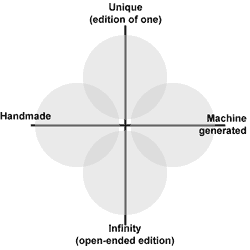
These two axis allow for many possibilities. For example, it would seem
certain that a totally handmade book would also be a unique edition,
or one of a kind. However, as crazy as it might be, some people choose
to produce artist's books which entail all sorts of processes by hand
in open-ended, or potentially infinite editions. And while it might
be logical to presume that a mechanical or electronic artist's book
would be produced in a very large edition, it too may be created as
a unique book in an edition of one. Why would someone go to all the
trouble of handsetting and proofing a letterpress text, using this mechanical
process invented specifically created to print large editions of books
instead of handwritten ones, for the sake of making a single copy? In
order to communicate an idea. Because an artist's book is a tool used
to explore and communicate ideas in a very individual way, and there
are endless means to these ends, often eccentric or controversial ones.
Another way to explain artist's books is by elimination,
that is, by stating what they are not:
They are not children's books
They are not sketch books.
They are not diaries.
They are not blank books.
They are not exhibition catalogs.
They are not reproductions of a body of an artist's work.
They are not art books(a common misnomer).
However, they may parody or play with any of the above, as well as all
other standard categories such as novels, self-help books, non-fiction,
cookbooks, operating manuals, manifestos, travel guides, essays, etc.
Artist's books function in the same way as contemporary art: as an expression
of someone's creativity, often with social commentary, but sometimes
in a purely abstract way, in absence of words or recognizable imagery.
Then should artist's books be considered a separate
category?
In the sense that they may adopt any and all forms of contemporary art,
such as painting, sculpture, photography, printmaking, installation
and performance art(necessarily including film and video) plus all forms
of "craft" which have crept into contemporary art on their
own, such as textiles or fiber art, bookbinding, typography, calligraphy,
papermaking, etc, maybe they shouldn't be a separate category. But the
category exists. At one time, in early nineteenth century America, the
profession of sculptor did not exist in the fine arts. Photography and
printmaking fought long and hard as well to be considered valid art
forms, not just mechanical means of reproduction. The category of artist's
books still confronts issues which no longer concern more established
forms of art. They remain obscure as well: there are many artists and
art collectors who have never heard of them.
What distinguishes artist's books from other art forms?
They are usually intended to be portable. They often come with specially
created cases or containers to help in the storage, protection and transportation
of the work. The cases are generally an integral part of the work itself,
the first step in the viewing process.
They are mixed-media. They combine many processes. So that once the
suite of photographs or prints or pulp paintings or weavings has been
completed, the work does not end there, as it might for a photographer
or printmaker or fiber artist. For someone making an artist's book,
it is just one step of the way. Printing the text, die-cutting, creating
a binding and a case, or preparing an installation, will often follow.
Ironically, the final confection, which may include a portfolio of prints,
paintings or photographs, might sell for less than a single, unbound
image of artwork.
They are usually supposed to be touched and interacted with, often with
a specific predetermined sequence. All of their physical attributes
are not visible at once. And in the process of manipulating them, their
multi-layered approaches attempt to manipulate you, just as the sequence
of a film or even an obstacle course.
A single work may have a number of different display possibilities.
Artist's books often have elements that may be arranged according to
the viewer's preference, hanging or flat. Or the work may be designed
to transform into a sculpture. An artist might interact with the book
during a performance, or the book may transform itself, perhaps through
melting, and be dubbed a "performance book".
They are generally not intended to decorate the collector's home. That
reduces the field of private collectors dramatically, including corporate
collections. It takes an unusual collector to buy art which, in being
meant to be touched, requires special care, and it takes an even rarer
breed to buy art that can't double as decoration, constantly on display
for all to see.
So who is most likely to buy artist's books?
Public collections: libraries, museums and university special collections,
which seek meaningful art regardless of its ability to adorn their walls.
However, preconceptions and polemics abound within public collecting.
There are debates within institutions about whether artist's books should
be collected or not. Curators of museums in the U.S. and abroad have
become upset that art librarians are spending money on artist's books,
instead of solely on research books. Some are incensed that librarians
function as curators; some resent that their own departments have no
budget to collect art, so why should the library be able to? These complaints
result at times in a mandate prohibiting the further purchase of artist's
books.
Some institutions are permitted to purchase artist's books, but only
collect books made by artists already represented in their collections
of painting, sculpture or contemporary art. This reflects an often-stated
bias that only artist's books made by artists established in other disciplines
are worthy of attention. Perhaps this indicates that those of us who
focus on artist's books should shun the title "book artist",
and call ourselves photographers or painters. Few artists, or people,
would choose to be pigeon-holed as to a style or category. Regardless,
we are what we're labeled in the media or in history. While wonderful
artists have certainly created some phenomenal artist's books, it is
equally true that people dabbling occasionally in the genre sometimes
fail to create effective works, because of problems with structure or
concept due to unfamiliarity with the medium. And while it may be true
at times that artist's books are purchased because they were created
by a certain well-known artist, it is often the case instead that a
work is purchased purely on the strength of its content, structure or
message, regardless of who made it. This makes the field of artist's
books a friendlier and more open subset of the contemporary art world.
However, every new curator or librarian brings specialties, strengths
and preferences to their job, and the quantity or variety of artist's
books being collected during each tenure will vary. As collections may
be broad, with many different kinds of holdings, each curator or librarian
will build on their institution's collections as they see fit. Sometimes,
the power of an individual to collect is transferred instead to a collections
committee within the institutions. This can work against artist's books,
as they often benefit from a personal demonstration by artist or dealer,
because of their multi-layered, sometimes subtle, approach. A prospectus
describing the work, perhaps in combination with a colophon within the
book, is often used to explain the work in absence of its creator.
The various issues raised above, while attempting to illuminate the
genre, also demonstrate why you may have never heard of artist's books.
The awareness of artist's books is surely increasing, judging from the
astounding number of courses, even university degrees, offered in the
book arts around the world, and due to the great number of exhibitions
in libraries and museums. Not to mention the numerous book arts organizations
and resources on the internet. But the road is slow, and many an enthusiastic
gallerist, dealer or venue dedicated to artist's books over the last
25 years closed its doors due to the difficulties of selling artist's
books while maintaining overhead costs. To be fair, this is true of
contemporary art venues in general and independent bookstores as well.
Even the most famous artist's book venue in the world, Printed Matter
in New York City, has struggled with chronic debt, unable at times to
pay artists for works sold. One of Printed Matter's founding board members,
the art critic Lucy Lippard, once confided in me that when they opened,
they thought artist's books would soon be found in every corner drugstore.
"Boy, were we wrong," she added. Susan Herter of Herter Studios,
during her tenure as editor at Chonicle Books in San Francisco, tried
very hard to promote trade editions, or mass-produced approximations,
of artist's books. Apart from the Griffin and Sabine series, which in
fact did a lot to expand the general public's perception of the possibilities
of book formats, Herter told me her efforts were unsuccessful.
But artist's books and the unusual experiences they offer are as alive
as ever, despite the difficulties of making them, selling them or physically
handling and displaying them. Why? Because people can't help creating
them and enjoying them. And if you still don't know what one is, the
easiest thing to do is to see some examples, so find one near you. Details
below.
© 2002 Angela Lorenz
Research in the Works
by Angela Lorenz
Sometimes I am referred to as a scholar, or
an author or poet. While I take this as a compliment, the only title I am sure
of is artist. Although Julia Child trained at the Cordon Bleu cooking school,
she always corrected people when they called her a chef. Cook was the only
title she ascribed to. I, too, am careful to point out that I avail myself of
scholarly research, conducted by properly trained, patient scholars, but I do
not create it.
Incorporating the fruits of scholarly
research into artists' books allows me to convey factual material, in
unexpected venues and formats, to a public that might not encounter it
otherwise. I am driven by my own curiosity, but seek
always to elicit it in others. Fascination comes easily to me—I am surprised at
how often some discredited or forgotten subject, object, or person from the
past relates directly to current events or contemporary trends. The trickster
in me enjoys drawing in the public by juxtaposing unlikely items from popular
culture with historical or arcane information. Delight in the mental challenge
of loading every element of the artworks with information is likely what drives
me to read so much scholarly material. I strive to be well informed, and to
link specialized information from different arenas.
Generally
speaking, a scholar sticks to one culture, one subject, or one century.
An artist can link disparate things in an effort to
provide new observations. Or in my case, to encourage others, especially
students, to embark on their own research, perhaps scholarly.
Much of my research is done in conventional
places, like libraries and museums. Ulisse Aldrovandi's Renaissance collection of natural artifacts in
Bologna, an early collection of curiosities, inspired me to consult his
manuscripts in the university library. The biographical reference material on Aldrovandi at the library enlarged my initial premise: I
did a broader work on the history of museums, instead of just about Aldrovandi's fake composite animals, in The Theater of
Nature or Curiosity Filled the Cabinet [Figure 3.1]. In the
course of my research, I learned about the content of early museums,
including asbestos, magnets, and medicinal plants, or simples. While reading, I
began to imagine how these materials could be included in the resulting
artist's book. Asbestos, woven into gloves and handkerchiefs as early museum
souvenirs and considered a natural wonder because inflammable, is now known to
be poisonous. So I used the equally flame resistant
purple mica Lepidolite as museum cabinet panes in the front cover of the book.
I do not often consult precious manuscripts in libraries. Usually reproductions or transparencies are shown to researchers, initially at least. Readers need a really good reason, and often credentials, to consult old or delicate works. But scholarly reference works abound in open stacks of public libraries and in journal articles now available on the Internet. Open stacks lining huge library walls in tiers might as well be a gourmet food emporia , for some kinds of bookworms, at least. In the open stacks of the Archiginnasio Library of Bologna, I consulted the Loeb series of Greek and Latin works, translated into English, for mentions of Roman wax tablet use for Wax Promises [Figure 3.2] and for references to sundials and early clocks for Librex Solaris [Figure 3.3]. The inspiration for both those works came from viewing historical objects in museums that suggested a structure appropriate for an artist's book: portable sunclocks in the Poldi-Pezzoli Museum in Milan and wooden Roman writing tablets from the Archeological Museum in Naples.
For Life, Life, Eternal Life: Uncle Wiggily Meets the Pilgrim's Progress [Figure 3.4], I consulted a few reference books on maps to find an appropriate graphic style. To my astonishment, one of the books had a map puzzle made of this novel in the 1700's, to teach children Christian values. I went to the British Library in London to consult the original puzzle, which turned out to be miniscule. So, I ordered the largest photographic reproduction available to enable me to study it at home. After all that, I only used three tiny images in the resulting work, on the covers of three pamphlets tucked inside pockets. In the end, it didn't feel right to label the places with names in this board game/artist's book. John Bunyan rails against the educated in his novel effort to bring Biblical knowledge to common people. In my work, I felt the need to communicate the places on the pilgrimage from the City of Destruction to the Celestial City in symbolic, allegorical ways, without using text.
The Johns Hopkins Library in Bologna, specialized in international relations and economics, proved useful for the work Binding Ties [Figure 3.5], which concerns the history of trade. But regarding research on regimental ties, libraries weren't helpful at all. Not even in the military academy at Sandringham, England. The Victoria & Albert Museum had nothing. Neither did the Guards Museum in London. I finally found what I needed in a few historic men's clothing stores, where proprietors let me photograph and sketch from their antique sample books of regimental ties. They also pointed me to the last regimental tie producer in East London, where I collected actual tie scraps and further reference material. The inspiration for this piece came from a chance find at an antique shop in Maine: a 1941 Parker Brothers board game called the "South American Travel and Trading Game." I was so horrified by this game, which taught young North Americans what raw materials to extract and what refined products to sell—a process known as the north-south transfer—I created this piece in response. Although as my research progressed, with the aid of Johns Hopkins economic professors, I realized that economic relations in history couldn't be so easily generalized. Accordingly, this work raises more questions than it answers.
Ephemera, book, and antique dealers have provided great materials and expertise for my projects. They are very much like librarians and curators, except they can sell their collections. Or let you photograph them and learn about them for free, if you are polite enough. Collecting plays an important part in my research, both for interesting formats and for content. Sometimes I'm not sure why I feel the need to purchase certain items, and often they serve a different purpose than intended. Quite often I buy ephemera, in the form of packaging and printed matter, for its graphic style or for its social history value. The statements on packaged items and advertising over the last century often seem ironic, humorous, or even hateful as they illuminate social views and trends of the past. Or sometimes I buy an old box or game because it has been reused or recycled by a previous owner. Usually these boxes come with contents, like it or not. But the old blue pencils inside the vintage pencil boxes came in handy for The Strength of Denham – Sir John Denham Jeans and Imitation Denhams [Figure 3.6] and the hundreds of antique pen nibs from their respective boxes were perfect for various symbolic uses on the game board of Life, Life, Eternal Life. This same work also benefited from a Victorian parlor game found in Bermondsey Market in London. I bought it because the claim on the cover ("an exciting parlour game") contrasted so heavily with the sad, lonely-looking little girl playing the game in the graphic. But the game itself served as my model for the catapult used to get players out of Vanity Fair, that place invented by Bunyan in The Pilgrim's Progress (1678). At the same London market I found an unusual structure for a book. It appears to be a cigar, but opens into a fan, apparently so men in Spain could have a fan at the opera, yet not have a feminine object in their pocket when not in use. Not wanting to waste such an unusual find, I waited for years for the most appropriate project in which to utilize it. For a future bookwork, I am going to make paper cigar fans containing text from works, read by employees known as lectors, which keep the workers in Cuban cigar factories entertained as they rolled cigars.
Sometimes the things I encounter in shops and markets are not for sale, like sample cards created by vendors to show their line of products, such as buttons or beads. I have often been successful in purchasing these from shopkeepers in different countries, like India and Italy, by paying the sum of the parts. Studies of sample cards and books, some collected, some found in museums, have been useful in several works, including Bologna Sample [Figure 3.7] and Riddle [Figure 3.8], based visually on paint and wallpaper sample books. I rarely use anything in a work in its original form, taking care to avoid the "preciousness" or inherent value of something antique, rare, or sentimental. Making facsimiles gives the idea without extra baggage. It is also easier to ensure the archival standards of the work, with acid-free paper and glue, when new materials are used. For example, instead of using my grandmother's ornate silk Victorian lace with palm trees and Greek friezes in Life, Life, Eternal Life, I scanned it and transferred the textile imagery onto sized white silk. I did use some antique textiles in the work, but I tried to transform them to neutralize them a bit—felting carded wool through lace or strategically cutting areas to abstract imagery.
Museums are my mainstay in research, however. What I find there is, without exception, followed up with research in books or questions to scholars. The contents of museums, and especially the labels and wall text, provide a lifetime of input. I have always loved the work of the artist Hans Holbein the Younger. In the Victoria & Albert Museum I came face to face with a tiny portrait painted by him of Sir Thomas More and his family household. The photographic, 3-D likenesses of figures as small as my thumb magnetized me, but the wall text was even more riveting. A lot of what I know about history, religion, and myth is through 30 years of art history, often self-taught. I never took a European History course in high school or college. I couldn't believe the irony, as I read the painting's label, that More was killed for his Mores. More's mores turned into "More's'mores " when I realized how the American junk food snack s'mores could be an appropriate vehicle for the peculiar life, potty-mouth Latin, and punning gallows humor of Sir Thomas More, beheaded by Henry VIII. I reproduced a drawing of More by Holbein, had it reduced and cast in bronze, and branded it onto cast-paper marshmallows, pierced with a slate pencil [Figure 3.9]. When More didn't have proper writing materials in prison, he used burnt wood and slate pencils to write. His head was displayed on a spike on London Bridge.
As much as I enjoy doing the research for each work, and writing essays and poetry stemming from this research, I could never renounce the physical making of art. The homo faber, or maker, in me needs to experiment with materials as well as words. My curiosity spills into the physical realm: what if I try to dye this paper with chocolate or pomegranates or saffron? What if I print on chewing gum? Or felt dust onto wool? What if I cook spaghetti and glue it on a printing plate? I am always looking for new materials. Specialized stores of all kinds, with solely cloth, plastic, fiber, or chemistry products, fill me with an overwhelming sense of potential. Italy is good for those types of supply venues. Or sometimes my supply source can be a complete surprise. On a trip to the city of Catania, in Sicily, I visited the treasure-filled Diocese museum hoping to find some interesting typologies of reliquaries for a work in process. At the top of the museum, there was a roof-top terrace, filled with piles of volcanic ash that had been accumulating during the ongoing eruption of Etna. I hadn't wanted to collect it from the street, as it mixed with dirt in the gutters. But here was a clean supply, which I scooped into my pockets and purse. I kept it for years, waiting for the right occasion. At the university library in Manchester, England, I discovered volcanic ash was used to make paintings by British women in the 18th century, perhaps by the Bluestocking member Mary Delany. Thus it seemed perfectly appropriate to mix the volcanic ash with glue, and use it to depict the threatening fire-and-brimstone place known as Mount Sinai on The Pilgrim's Progress game board.
I have often benefited from casual exchanges of information with strangers in airports or other venues in the daily path of life. I had learned about nose contests from an ephemera dealer in Bologna, who sold me a gummed stamp from a nose contest at Carnival in Italy. But it was in a Milan airport that a Turkish student travelling back to her university in America that I learned of nose contests in her town on the Black Sea. Having the opportunity to talk to a dedicated scholar or a person who has acquired great cultural knowledge through experience is for me akin to stepping into a warehouse of materials or an astounding collection of historical artifacts in a museum. I may pooh-pooh the ancient practitioners of alchemy and the Renaissance seekers of universal knowledge through mystical diagrams and memory theaters, but perhaps my own goals and appetite for knowledge are similarly unrealistic. I can't help it: a sense of awe originates from my perception of being in the presence of great resources, human or inanimate. Tony Zwicker, with her incredible overview of artists' books and scholars, provided that sense of wonder for me in her cabinet of curiosities at the New York Arts Club. Her acute critical prowess and direct, questioning manner transfixed many of us. She prodded artists until she was satisfied of their intentions, and their knowledge. I don't think artists need necessarily to have intentions, or to necessarily make them known to others. But as my intent is to represent and circulate information, albeit in an unusual guise, I have greatly benefited from the scholarship of dealers, academics, collectors, and vendors alike, as well as the occasional cab-driver.
Angela Lorenz, 2010